-People like to talk and eat at the same time.
-People often slurp while drinking soup.
-childrens loves to bang their utensils together to make funny noises.
Wednesday, March 5, 2008
Bad Habit That People Do While Eating
Tuesday, March 4, 2008
chicken chop

Looks really juicy and aromatic after the gravy is poured atop.
So, how does it actually taste? It’s very nice actually. A whole deboned thigh which taste exactly like the original recipe fried chicken, but with additional aromatic and yummy mushroom sauce! If you love their friend chicken, you must give this a try.
Anyway, perhaps the portion is a bit small, if you are a big eater like myself, you may want to order an additional Zinger Burger
So, how does it actually taste? It’s very nice actually. A whole deboned thigh which taste exactly like the original recipe fried chicken, but with additional aromatic and yummy mushroom sauce! If you love their friend chicken, you must give this a try.
Anyway, perhaps the portion is a bit small, if you are a big eater like myself, you may want to order an additional Zinger Burger
Sushi

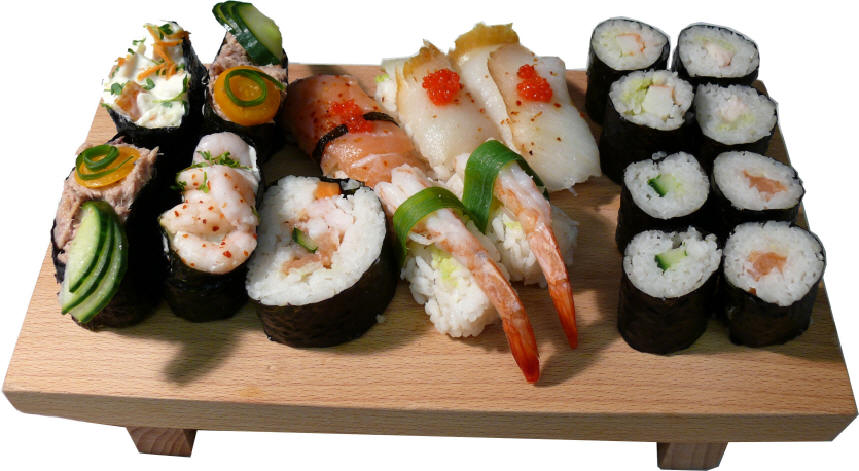
In Japanese cuisine, sushi is vinegared rice, usually topped with other ingredients including fish (cooked or uncooked) and vegetables. Outside of Japan, sushi is sometimes misunderstood to mean the raw fish by itself, or even any fresh raw-seafood dishes. In Japan, sliced raw fish alone is called sashimi and is distinct from sushi, as sashimi is the raw fish component, not the rice component.
There are various types of sushi: sushi served rolled inside (dried and pressed layer sheets of seaweed or alga) called makizushi or rolls; sushi made with toppings laid with hand-formed clumps of rice called nigirizushi toppings stuffed into a small pouch of fried tofu called inarizushi; and toppings served scattered over a bowl of sushi rice called chirashi-zushi.
There are various types of sushi: sushi served rolled inside (dried and pressed layer sheets of seaweed or alga) called makizushi or rolls; sushi made with toppings laid with hand-formed clumps of rice called nigirizushi toppings stuffed into a small pouch of fried tofu called inarizushi; and toppings served scattered over a bowl of sushi rice called chirashi-zushi.
By Muhd Irfan Bin Johari
Sunday, March 2, 2008
Thosai

The thosai is a South Indian crêpe. This food, high in carbohydrates and proteins, is a typical South Indian breakfast recipe.Though considered a breakfast dish, dosas are also eaten at other times of day. Those with wheat allergies or gluten intolerance will find the dosa a nice addition to their diets. They can be stuffed with vegetables, meats and sauces to create a quickly prepared meal.
Dosas are typically served with a side accompaniment which varies according to regional and personal preferences.
Dosas are typically served with a side accompaniment which varies according to regional and personal preferences.
Masala Thosai
A masala dosa is made by stuffing a dosa with a lightly cooked filling of potatoes, fried onions and spices.
One variant of the masala dosa, the Mysore masala mosa, is served with both coconut and onion chutneys. In Bengalooru, the masala dosa is usually served with a red chutney applied to its inside surface. This peculiarity lends itself to a unique taste and is something that is not found elsewhere. The red chutney usually has generous amounts of garlic (traditionally garlic is not used in masala dosa especially in the Brahmin community), and adds a nice flavor to the dosa when it is fried with ghee. In recent times this has become popular in other parts of Karnataka. Davanagere benne masala dose is another variant of the masala dosa from Karnataka. It is named after Davanagere in Karnataka. It is prepared by adding liberal doses of butter (benne) and also a potato filling (palya) that is unique. It is devoid mostly of any extra ingredients and is just mashed potato. The Rave dosa or Rava dosa is another variant that along with, Rave idly was popularised by Mavalli Tiffin Rooms of Bengalooru. Ragi dosa and Ade or Aday dosa are other variants that are native to Karnataka.
One variant of the masala dosa, the Mysore masala mosa, is served with both coconut and onion chutneys. In Bengalooru, the masala dosa is usually served with a red chutney applied to its inside surface. This peculiarity lends itself to a unique taste and is something that is not found elsewhere. The red chutney usually has generous amounts of garlic (traditionally garlic is not used in masala dosa especially in the Brahmin community), and adds a nice flavor to the dosa when it is fried with ghee. In recent times this has become popular in other parts of Karnataka. Davanagere benne masala dose is another variant of the masala dosa from Karnataka. It is named after Davanagere in Karnataka. It is prepared by adding liberal doses of butter (benne) and also a potato filling (palya) that is unique. It is devoid mostly of any extra ingredients and is just mashed potato. The Rave dosa or Rava dosa is another variant that along with, Rave idly was popularised by Mavalli Tiffin Rooms of Bengalooru. Ragi dosa and Ade or Aday dosa are other variants that are native to Karnataka.
Other types of thosai include:
Egg thosai - a dosa spread with an omelette.
Chilli thosai - idli powder is spread on the dosa.
Onion thosai - chopped and sautéd onions are spread on the dosa.
Ghee (thuppa/neyyi) thosai - ghee is used instead of oil while frying the thosai.
Butter thosai - butter is used instead of oil while frying dosa and a small amount on top of it while serving.
Roast - the thosai is spread thinly and fried until crisp.
Family roast - a long thosai which can be spread over 2 or 3 feet.
Paper thosa - a long and very thin delicate thosa which can be spread over 2 feet.
Green thosai - a thosai stuffed with fresh vegetables and mint chutney.
Chow-chow thosai - a dosa stuffed with (Indian flavored) Chinese noodles.
Cheese thosai - a dosa stuffed with cheese.
Masala thosai - a long thin dosa made with different spices, which can also be spread over 2 feet.
Egg thosai - a dosa spread with an omelette.
Chilli thosai - idli powder is spread on the dosa.
Onion thosai - chopped and sautéd onions are spread on the dosa.
Ghee (thuppa/neyyi) thosai - ghee is used instead of oil while frying the thosai.
Butter thosai - butter is used instead of oil while frying dosa and a small amount on top of it while serving.
Roast - the thosai is spread thinly and fried until crisp.
Family roast - a long thosai which can be spread over 2 or 3 feet.
Paper thosa - a long and very thin delicate thosa which can be spread over 2 feet.
Green thosai - a thosai stuffed with fresh vegetables and mint chutney.
Chow-chow thosai - a dosa stuffed with (Indian flavored) Chinese noodles.
Cheese thosai - a dosa stuffed with cheese.
Masala thosai - a long thin dosa made with different spices, which can also be spread over 2 feet.
Nasi Lemak

Nasi lemak is a dish that is commonly sold in Malaysia, Brunei, Singapore and Souther Thailand.
With roots in Malay culture, its name is a Malay word that literally means 'rice in cream'. The name is derived from the cooking process whereby rice is soaked in rich coconut cream and then the mixture steamed. Sometimes knotted screwpine (pandan) leaves are thrown into the rice while steaming to give it more fragrance. Herbs such as ginger (common in Malay cuisine) and occasionally lemon grass may be added for additional fragrance.
Traditionally, this comes as a platter with cucumber slices, small dried anchovies (ikan bilis), roasted peanuts, stir fried water convolvulus (kangkong), hard boiled egg, pickled vegetables (achar) and hot spicy sauce (sambal). Nasi lemak can also come with any other accompaniments such as chicken, cuttlefish, cockle, beef curry (beef stewed in coconut milk and spices) or paru (beef lungs). Traditionally most of these accompaniments are spicy in nature.
Nasi lemak is traditionally a breakfast dish, and it is sold early in the morning at roadside stalls in Malaysia, where it is often sold packed in newspaper, brown paper or banana leaf. However, there are restaurants which serve it on a plate as noon or evening meals, making it possible for the dish to be treated as a delicacy. 'Nasi lemak panas' meaning hot nasi lemak is another name given to nasi lemak serve with hot cooked rice.
Saturday, March 1, 2008
Hokkien mee


Hokkien mee refers to fried noodles cooked in Hokkien (Fujian) style. Hokkien mee is served in Malaysia and Singapore and was brought there by immigrants from Fujian Province in southeastern China.
There are two types of Hokkien mee: Hokkien Hae Mee(Hokkien prawn noodles) is commonly served in Penang and Singapore while Hokkien char mee (Hokkien fried noodles) is commonly served in Kuala Lumpur and the Klang Valley. The dish commonly referred to as "Hokkien mee", depending on the locality, can mean either Hokkien hae mee or Hokkien char mee. For example, Hokkien mee in Kuala Lumpur refers to Hokkien char mee.
Hokkien Hae Mee
Hokkien Hae Mee is a dish of egg noodles and rice noodles in a fragrant stock, which is made from both fresh shrimp and dried prawns, as well as pork or chicken. Traditionally, small cubes of fried pork fat are added to the soup, but this is now less common due to health concerns. It is garnished with prawns, fish cake, leafy greens, pork ribs, squid, vegetables, crisp deep-fried shallots, spring onions and fresh lime. The dish is served with sliced red chili, light soy sauce and sambal.
Hokkien Char Mee
Hokkien Char Mee is a dish of thick yellow noodles braised in thick dark soy sauce with pork, squid, fish cake and cabbage as the main ingredients and cubes of pork fat fried until crispy.
By Lian Wen Wei Alexander
Subscribe to:
Posts (Atom)