Wednesday, August 27, 2008
Tuesday, August 26, 2008
Older Generation Interview
Interviewer: Irfan
Interviewee: Maimunah
Q: What is your favourite traditional food?
A: My favourite traditional food is 'Gado-gado'.
Q: Do you know the history of your traditional food?
A: It came from Indonesia.
Q: Why do you like that food?
A: I t is appetizing and nutritional.
Q: Do you know the ingredients of your favourite traditional food?
A: Of course. They are; vegetables, fried crackers, tofu, potatoes, peanuts, 'tempe' which is fermented soya beans and more.
Tuesday, August 19, 2008
Interviewing The Younger Generation
Interviewer: Haziq
Interviewee: Fadhil
Q:You like Ketupat, but do you know the history of it?
Response: I don't know about the history, I just eat it.
Q: When is ketupat usually eaten?
Response: Usually it is eaten during Hari Raya or any other malay festivities. Sometimes people also eat ketupat with satay.
Q: Why do you think the ketupat is wrapped with leaves?
Response: To keep it together so that it does not seperate while boiling. I think it has also got to do with the smell or fragrance.
Q: Have you ever made a ketupat before?
Response: Yes, I sometimes help my grandmother to make ketupat before Hari Raya. It is very fun but also quite challenging. When you wrap the ketupat, it is like solving a Rubik's Cube
Conclusions
- Most of the younger generation do not know the history of their favourite food or traditional food. They just enjoy what they are eating. But, some of them are curious and are willing to find out about it.
Tuesday, August 12, 2008
Interview on Traditional Food ( Rice Dumpling )
Older Generation
Interviewer : Jensen
Interviewee: Francis
 A Rice Dumpling without cover
 A Picture of the rice dumpling
Q1. When was Rice Dumpling usually ate?
Responses. During Dragon Boat Festival which is the on the fifth day of the fifth month of the chinese calendar.
Q2. What is the story behind rice dumpling?
Responses. When Qin Dynasty general Bai Qi took over Chu capital , Qu Yuan's grief was so intense that he drowned himself in the Miluo River.Dumpling were than thrown into the river to prevent fishes in the river from eating his body
Q3. What is the traditional filling for the Rice Dumpling?
Responses. Meat , Mushrooms and groundnuts
Q4.Why is the rice dumpling ate?
Responses. It is eaten to commemorating the death of Qu Yuan , a famous Chinese poet from the Kingdom of Chu who lived through the warring states period.
Conclusions
Usually eaten on the fifth day of the fifth month to commemorate the death of Qu Yuan and that normally filled with meat , mushrooms and groundnut
Attitude of people today towards traditional food
Some of them do not bother finding the history of the food they like
Interviewing The Younger Generation
Interviewer : Alexander
Interviewee : Josephine
Q1 when you eat traditional food, do you bother to know its history? Why?
Responses: No i don't. There is no point as finding out its history is not important because I think that there is no use in finding it anyway.
Q2 If you knew the history of tradition food , woukd you tell them to other people ? Why ?
Responses: No. I would not or perhap sometime . Most people do not care so I have no reason to tell them . In Fact , the history of traditional food is not so important to me
Q3 Which religion's tradition food do you perfer most?
Responses: It can be any religion as I go for the taste of the food rather than the religion of the food . I don't think anyone would only prefer one religion's food as I think many people would want to try more new foods .
Q4 Do you know any history of a traditional food? How did you get to know it?
Responses: Of course. I do know alot of chinese traditional food historys in fact , there is too much to write down . I get these information from family members , friends , classmates , schoolmates as well as teachers.Sometimes I get these information when they share their stories with me .
checking research findings:
To get more people to know more about the history of traditional food, one good possible way is through interactions with people around from different races.
Attitude of people today towards traditional food:
They think it is not important and say that there is no reason why they should care at all.
Wednesday, July 30, 2008
Growing Bread Moulds
Day 11...Just in case it needs one more day. But nothing grows...
 Day 9
Day 9 Day 8
Day 8 Day 7
Day 7 Day 6
Day 6 Day 5
Day 5
Day 4
Day 3
Day 2
Day 1
The Pictures above are pictures that had no sunlight and kept in ziplock bag for 10 days
Day 10
Day 9
Day 8


Day 7

Day 6

Day 5

Day 4

Day 3

Day 2

Day 1

Day 3

Day 2

Day 1
Above is the bread that is kept in a Ziplock bag and left
on the table to grow mould for 10 days!
Tuesday, July 29, 2008
Exploring further
Harmful effects of consuming too much acid
-Cause the gums to become more swollen
3 types of acidic food
-Plums
-Cranberries and Blueberries
-Prunes
In some instances, our stomach may produce excessive acid.
Below is a suggestion what a person may consume to treat this problem.
-milk

Tuesday, July 1, 2008
MOULD
What is bread mould ?
It is fungus growing on decaying bread.
What are the similarities and differences between bread mould compared to plants and animals ?
- Bread Mould does not make food like animals but plants can make food
-All 3 needs water to survive,
Where and how should bread be stored to keep it free from moulds ?
Its should be store at room temperature in a cool , dry place . Refrigeration speeds up staling.However , in hot , humid weather , bread kept more than 2-3 days should be refrigerated to retard mold growth.
What other foods do you think might grow moulds if left exposed?
-cheese
Suggest 3 ways of preserving food without the use of refrigerators?
- Storage
- Drying
- Canning
Simple storage is, by far, the oldest method of preserving food. It's also the easiest. Perishables to be kept by this process are merely placed in a cool, dry environment such as a cellar or specially-constructed hole in the ground. Only a limited number of fruits and vegetables can be preserved in this fashion, however, and only for a limited period of time.
Tuesday, April 22, 2008
Thursday, April 17, 2008
3 Other blogs
There are a lot of bloggers blogging about food, and we mean thousands of them, but we have chosen 3 blogs that have interested us:
http://www.makansutra.com/index.php
http://www.moblog.com.sg/group/home.asp?gid=BF5D672F-0ED7-4326-9659-B7E83CE9D332
http://www.hungrygowhere.com/
Wednesday, March 5, 2008
Bad Habit That People Do While Eating
-People like to talk and eat at the same time.
-People often slurp while drinking soup.
-childrens loves to bang their utensils together to make funny noises.
Tuesday, March 4, 2008
chicken chop

Looks really juicy and aromatic after the gravy is poured atop.
So, how does it actually taste? It’s very nice actually. A whole deboned thigh which taste exactly like the original recipe fried chicken, but with additional aromatic and yummy mushroom sauce! If you love their friend chicken, you must give this a try.
Anyway, perhaps the portion is a bit small, if you are a big eater like myself, you may want to order an additional Zinger Burger
So, how does it actually taste? It’s very nice actually. A whole deboned thigh which taste exactly like the original recipe fried chicken, but with additional aromatic and yummy mushroom sauce! If you love their friend chicken, you must give this a try.
Anyway, perhaps the portion is a bit small, if you are a big eater like myself, you may want to order an additional Zinger Burger
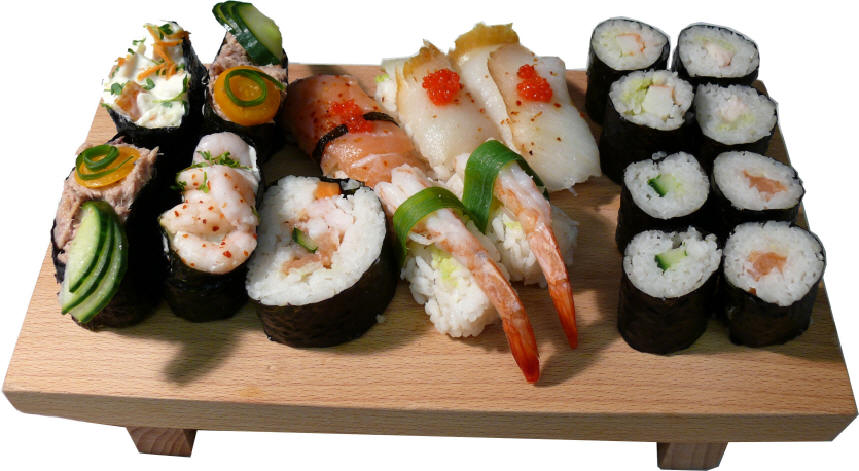
Sushi

In Japanese cuisine, sushi is vinegared rice, usually topped with other ingredients including fish (cooked or uncooked) and vegetables. Outside of Japan, sushi is sometimes misunderstood to mean the raw fish by itself, or even any fresh raw-seafood dishes. In Japan, sliced raw fish alone is called sashimi and is distinct from sushi, as sashimi is the raw fish component, not the rice component.
There are various types of sushi: sushi served rolled inside (dried and pressed layer sheets of seaweed or alga) called makizushi or rolls; sushi made with toppings laid with hand-formed clumps of rice called nigirizushi toppings stuffed into a small pouch of fried tofu called inarizushi; and toppings served scattered over a bowl of sushi rice called chirashi-zushi.
There are various types of sushi: sushi served rolled inside (dried and pressed layer sheets of seaweed or alga) called makizushi or rolls; sushi made with toppings laid with hand-formed clumps of rice called nigirizushi toppings stuffed into a small pouch of fried tofu called inarizushi; and toppings served scattered over a bowl of sushi rice called chirashi-zushi.
By Muhd Irfan Bin Johari
Sunday, March 2, 2008
Thosai

The thosai is a South Indian crêpe. This food, high in carbohydrates and proteins, is a typical South Indian breakfast recipe.Though considered a breakfast dish, dosas are also eaten at other times of day. Those with wheat allergies or gluten intolerance will find the dosa a nice addition to their diets. They can be stuffed with vegetables, meats and sauces to create a quickly prepared meal.
Dosas are typically served with a side accompaniment which varies according to regional and personal preferences.
Dosas are typically served with a side accompaniment which varies according to regional and personal preferences.
Masala Thosai
A masala dosa is made by stuffing a dosa with a lightly cooked filling of potatoes, fried onions and spices.
One variant of the masala dosa, the Mysore masala mosa, is served with both coconut and onion chutneys. In Bengalooru, the masala dosa is usually served with a red chutney applied to its inside surface. This peculiarity lends itself to a unique taste and is something that is not found elsewhere. The red chutney usually has generous amounts of garlic (traditionally garlic is not used in masala dosa especially in the Brahmin community), and adds a nice flavor to the dosa when it is fried with ghee. In recent times this has become popular in other parts of Karnataka. Davanagere benne masala dose is another variant of the masala dosa from Karnataka. It is named after Davanagere in Karnataka. It is prepared by adding liberal doses of butter (benne) and also a potato filling (palya) that is unique. It is devoid mostly of any extra ingredients and is just mashed potato. The Rave dosa or Rava dosa is another variant that along with, Rave idly was popularised by Mavalli Tiffin Rooms of Bengalooru. Ragi dosa and Ade or Aday dosa are other variants that are native to Karnataka.
One variant of the masala dosa, the Mysore masala mosa, is served with both coconut and onion chutneys. In Bengalooru, the masala dosa is usually served with a red chutney applied to its inside surface. This peculiarity lends itself to a unique taste and is something that is not found elsewhere. The red chutney usually has generous amounts of garlic (traditionally garlic is not used in masala dosa especially in the Brahmin community), and adds a nice flavor to the dosa when it is fried with ghee. In recent times this has become popular in other parts of Karnataka. Davanagere benne masala dose is another variant of the masala dosa from Karnataka. It is named after Davanagere in Karnataka. It is prepared by adding liberal doses of butter (benne) and also a potato filling (palya) that is unique. It is devoid mostly of any extra ingredients and is just mashed potato. The Rave dosa or Rava dosa is another variant that along with, Rave idly was popularised by Mavalli Tiffin Rooms of Bengalooru. Ragi dosa and Ade or Aday dosa are other variants that are native to Karnataka.
Other types of thosai include:
Egg thosai - a dosa spread with an omelette.
Chilli thosai - idli powder is spread on the dosa.
Onion thosai - chopped and sautéd onions are spread on the dosa.
Ghee (thuppa/neyyi) thosai - ghee is used instead of oil while frying the thosai.
Butter thosai - butter is used instead of oil while frying dosa and a small amount on top of it while serving.
Roast - the thosai is spread thinly and fried until crisp.
Family roast - a long thosai which can be spread over 2 or 3 feet.
Paper thosa - a long and very thin delicate thosa which can be spread over 2 feet.
Green thosai - a thosai stuffed with fresh vegetables and mint chutney.
Chow-chow thosai - a dosa stuffed with (Indian flavored) Chinese noodles.
Cheese thosai - a dosa stuffed with cheese.
Masala thosai - a long thin dosa made with different spices, which can also be spread over 2 feet.
Egg thosai - a dosa spread with an omelette.
Chilli thosai - idli powder is spread on the dosa.
Onion thosai - chopped and sautéd onions are spread on the dosa.
Ghee (thuppa/neyyi) thosai - ghee is used instead of oil while frying the thosai.
Butter thosai - butter is used instead of oil while frying dosa and a small amount on top of it while serving.
Roast - the thosai is spread thinly and fried until crisp.
Family roast - a long thosai which can be spread over 2 or 3 feet.
Paper thosa - a long and very thin delicate thosa which can be spread over 2 feet.
Green thosai - a thosai stuffed with fresh vegetables and mint chutney.
Chow-chow thosai - a dosa stuffed with (Indian flavored) Chinese noodles.
Cheese thosai - a dosa stuffed with cheese.
Masala thosai - a long thin dosa made with different spices, which can also be spread over 2 feet.
Nasi Lemak

Nasi lemak is a dish that is commonly sold in Malaysia, Brunei, Singapore and Souther Thailand.
With roots in Malay culture, its name is a Malay word that literally means 'rice in cream'. The name is derived from the cooking process whereby rice is soaked in rich coconut cream and then the mixture steamed. Sometimes knotted screwpine (pandan) leaves are thrown into the rice while steaming to give it more fragrance. Herbs such as ginger (common in Malay cuisine) and occasionally lemon grass may be added for additional fragrance.
Traditionally, this comes as a platter with cucumber slices, small dried anchovies (ikan bilis), roasted peanuts, stir fried water convolvulus (kangkong), hard boiled egg, pickled vegetables (achar) and hot spicy sauce (sambal). Nasi lemak can also come with any other accompaniments such as chicken, cuttlefish, cockle, beef curry (beef stewed in coconut milk and spices) or paru (beef lungs). Traditionally most of these accompaniments are spicy in nature.
Nasi lemak is traditionally a breakfast dish, and it is sold early in the morning at roadside stalls in Malaysia, where it is often sold packed in newspaper, brown paper or banana leaf. However, there are restaurants which serve it on a plate as noon or evening meals, making it possible for the dish to be treated as a delicacy. 'Nasi lemak panas' meaning hot nasi lemak is another name given to nasi lemak serve with hot cooked rice.
Saturday, March 1, 2008
Hokkien mee


Hokkien mee refers to fried noodles cooked in Hokkien (Fujian) style. Hokkien mee is served in Malaysia and Singapore and was brought there by immigrants from Fujian Province in southeastern China.
There are two types of Hokkien mee: Hokkien Hae Mee(Hokkien prawn noodles) is commonly served in Penang and Singapore while Hokkien char mee (Hokkien fried noodles) is commonly served in Kuala Lumpur and the Klang Valley. The dish commonly referred to as "Hokkien mee", depending on the locality, can mean either Hokkien hae mee or Hokkien char mee. For example, Hokkien mee in Kuala Lumpur refers to Hokkien char mee.
Hokkien Hae Mee
Hokkien Hae Mee is a dish of egg noodles and rice noodles in a fragrant stock, which is made from both fresh shrimp and dried prawns, as well as pork or chicken. Traditionally, small cubes of fried pork fat are added to the soup, but this is now less common due to health concerns. It is garnished with prawns, fish cake, leafy greens, pork ribs, squid, vegetables, crisp deep-fried shallots, spring onions and fresh lime. The dish is served with sliced red chili, light soy sauce and sambal.
Hokkien Char Mee
Hokkien Char Mee is a dish of thick yellow noodles braised in thick dark soy sauce with pork, squid, fish cake and cabbage as the main ingredients and cubes of pork fat fried until crispy.
By Lian Wen Wei Alexander
Friday, February 29, 2008

Hainanese chicken rice is a Chinese rice dish commonly associated with Malaysian cuisine or Singaporean cuisine, although it is also commonly sold in neighbouring Thailand, and found in Hainan, China itself. Due to its roots in Hainan cuisine and its adoption by the Hainanese overseas Chinese population in the Nanyang area, the version found in Malaysia/Singapore combines elements of Hainanese and Cantonese cuisines along with culinary preferences in the Southeast Asian region. The food came from china.
The Hainanese prefer using older chicken to maximise the amount of oil extracted, thus creating a more flavourful dish.The chicken is prepared in traditional Hainanese methods which involve the boiling of the entire chicken in a pork and chicken bone stock, reusing the broth over and over and only topping it up with water when needed, in accordance with the Chinese preferences for creating "master stocks". This stock is not used for rice preparation, which instead involves chicken stock created specifically for that purpose, producing an oily, flavourful rice sometimes known as "oily rice".
By Lian Wen Wei Alexander
Claypot rice

This dish desirably is cooked in a clay pot on charcoal stove as the rice will form a brown , crispy layer at the bottom of clay pot, thus making the rice more fragrant. By:Jensen
Laksa

Laksa is a bowlful of noodles in a unique soupbase which blends the Chinese and Malay styles of cooking. There are 2 distinct types of laksas namely, the tamarind-based assam laksa and the coconut-based laksa lemak, although there are many variations of these types.
By:Jensen
Thursday, February 28, 2008
Ban Mian(Chinese Noodle)

Ban mian is a Hokkien-style egg noodle soup common in parts of China's Fujian province, and also in other parts of the world such as Singapore and Malaysia, although the dish itself may vary significantly. Some forms of ban mian, for instance, comprise hand-kneaded pieces of dough, while others use regular strips of noodles.
Ban mian is so named due to the characteristic flat shape of its noodles.
By:Jensen
Subscribe to:
Posts (Atom)